Hermes Agent 0.20: voice, A2A, and the desktop shift
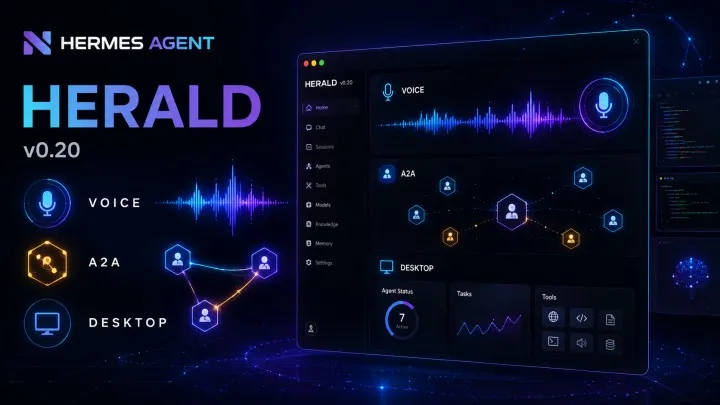
In short: As of September 5, 2026, Hermes Agent 0.21.0 is the latest stable release, while 0.20.0 “Herald” remains the release that introduced conversational voice, A2A v1.0, signed webhooks, and the expanded desktop. For a new installation, choose the latest version; to assess these foundational features, 0.20 remains the right reference point.
Published on August 3, 2026, the official Hermes Agent 0.20.0 release turned the terminal agent into a broader platform. If you are new to the project, our April 2026 comparison with OpenClaw lays the groundwork. Here, the goal is to separate Herald’s contributions from the product’s current state.
| Feature | Category | Impact |
|---|---|---|
| Real-time voice with interruption | Interface | More natural hands-free conversation |
| On-device wake words | Privacy | Audio stays local before activation |
| A2A v1.0 | Interoperability | Communication across different agent stacks |
| Signed outbound webhooks | Integration | Events that receivers can verify |
| Search with verifiable citations | Reliability | Claims tied to consulted pages |
| Artifacts with live preview | Desktop | Visual iteration inside the conversation |
| Plugin SDK and multiple windows | Desktop | Extensible workspace |
| Per-turn micro-compaction | Context | More gradual compression |
Where does Hermes Agent 0.20 stand today?
Hermes Agent is developed by Nous Research under the MIT license, as shown in its official repository. Version 0.20.0 uses the v2026.8.3 tag. It is no longer the latest release: the Hermes Agent 0.21.0 release notes date the next stable version to August 31, 2026.
The rest of this article therefore describes the features introduced with Herald, not every capability available in the current release.
How does conversational voice work?
Version 0.20 introduces a voice mode designed for dialogue rather than a simple sequence of dictated turns.
Streaming with interruption
Speech synthesis starts during generation and progresses in segments. You can speak during the response: Hermes stops playback, listens, and tells the model that you interrupted. The official release notes describe this behavior across the CLI, desktop, and audio-capable gateways.
On-device wake words
You can choose a wake phrase. Detection runs on the device: according to the release notes, no audio leaves your machine while it waits. Different profiles can also receive different wake phrases.
Key point: Herald makes voice interaction genuinely conversational. For sensitive use, you should still check your transcription engine, voice engine, and where requests go after activation.
What does A2A v1.0 enable in Hermes?
The Agent2Agent 1.0 protocol is an open standard for communication between independent agent systems. Its specification covers capability discovery, messages, tasks, artifacts, and several protocol bindings, including JSON-RPC, gRPC, and HTTP with JSON.
Hermes 0.20 includes a bidirectional A2A plugin. According to the Herald notes, it can discover and contact compatible agents and can also be driven by them. The main benefit is connecting agents built with different stacks without giving them access to each other’s internal state.
When to use it: delegate research, analysis, or generation to a specialized agent. Keep authentication strict and limit exposed capabilities; the protocol provides interoperability, not a ready-made trust policy.
How do webhooks and citations improve reliability?
Signed outbound webhooks
Hermes 0.20 can send lifecycle events to a registered HTTP endpoint. The release notes mention session activity, turn completions, and tool events. HMAC signatures let the receiving service check the authenticity of incoming messages.
This feature suits dashboards, CI, and automation. The receiver should always verify the signature before processing an event.
Search with verifiable citations
The grounded-citations skill ties claims to pages that were actually consulted and matches citations against the source text. Its fact-checking mode separates what is confirmed, contradicted, or impossible to verify. This description comes from the official Herald release notes; it does not guarantee that every external source is accurate or current.
Why does the desktop become a platform?
The desktop app goes beyond the role of a graphical terminal.
Artifacts with live preview
Artifacts are versioned cards. A sandboxed preview can show the result beside the conversation, so you can iterate on an interface or document without switching applications.
Plugin SDK
Herald introduces a plugin SDK, with Kanban highlighted as its first plugin. The release notes also mention file downloads through ctx.download and floating pane placement.
Multiple windows and remote access
The desktop supports multiple windows and a quick-entry window available through a global shortcut. An SSH backend can also connect the application to a remote Hermes instance.
Which commands does the 0.20 CLI add?
The CLI gains shortcuts that avoid handing deterministic operations to the model:
! ls -la src/     # run a shell command directly
/init             # generate or update AGENTS.md
/diff             # show project or session changes
/context          # break down context usage
/focus            # reduce output and retrieve hidden lines
The ! prefix runs the command without spending a model turn. Herald also adds prompt stashing with Ctrl+S and an import command for Claude Code or Codex CLI setups.
How does context compression change?
Version 0.20 spreads more compression work across turns. It proactively prunes tool results, preserves a tail of recent user messages, and accepts model-specific thresholds. [SKILL_PRUNED] markers expose when a skill has been removed from the context.
The goal is simple: reduce abrupt pauses and preserve recent exchanges. This mechanism improves context management, but it does not replace structured project memory or verification of important information.
Conclusion
Hermes Agent 0.20 “Herald” is a clear milestone: conversational voice, A2A interoperability, signed events, grounded citations, and an extensible desktop. For a current installation, use Hermes Agent 0.21.0 or a later stable release. To understand when Hermes moved from terminal agent to agent platform, 0.20 remains the reference.
Sources
Frequently asked questions
What is the latest version of Hermes Agent?
As of September 5, 2026, the latest stable release is Hermes Agent 0.21.0, identified by the v2026.8.31 tag. This article remains focused on the features introduced by Hermes Agent 0.20.0 Herald.
What are the main new features in Hermes Agent 0.20?
Hermes Agent 0.20 adds conversational voice with interruption, A2A v1.0, signed outbound webhooks, verifiable citations, and a richer desktop. The CLI and context compression also improve.
Can Hermes Agent 0.20 communicate with other agents?
Yes. Its A2A plugin lets Hermes discover and contact compatible agents, while also allowing those agents to drive Hermes.
Should you install Hermes Agent 0.20 today?
Not for a new installation: choose the latest stable release. Use this article to understand the voice, A2A, and desktop foundation introduced by the 0.20 line.