Why choose Hermes Agent over OpenClaw
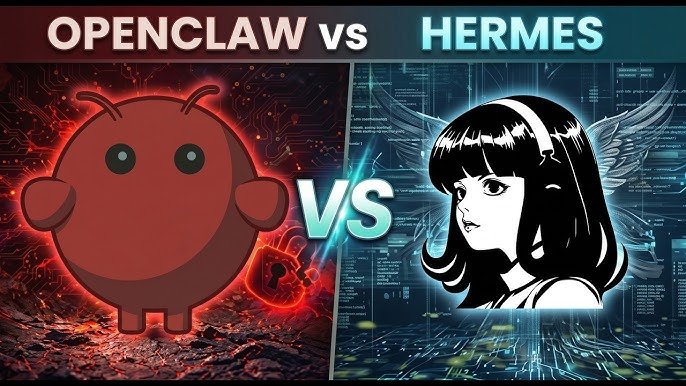
Autonomous AI agents experienced explosive growth in 2025-2026. Two open-source projects stand out in this space: Hermes Agent developed by Nous Research, and OpenClaw originally launched as Claude Bot. Both offer autonomous agents running on your server with messaging integration. Their philosophies and capabilities differ significantly though.
Overview
Hermes Agent
Developed by Nous Research, a respected AI lab known for the Hermes model series. Launched July 2025 with the tagline “the agent that grows with you.”
Key features include a closed learning loop with persistent memory, autonomous skill creation from experience, flexible infrastructure support from a five dollar VPS to GPU clusters, fifteen or more messaging platforms, and a MIT license making it fully open-source.
OpenClaw
OpenClaw is an open-source autonomous AI agent initially launched as Claude Bot in November 2025. It exploded in popularity reaching over 350,000 GitHub stars by early 2026.
Key features include a self-hosted gateway with multi-channel architecture, multi-model support, a skills marketplace called ClawHub with over ten thousand skills, native webhooks, and a control UI for session management.
Memory and learning
Hermes Agent features a true closed learning loop. It creates skills autonomously after complex tasks, improves them during ongoing use, and builds a deepening model of your preferences across sessions. Memory is agent-curated with periodic nudges and FTS5 search with LLM summarization.
OpenClaw offers structured wiki-style memory with claim and evidence fields. Skill creation is manual through SKILL.md files. The system includes semantic search with freshness weighting and staleness dashboards.
Hermes wins on autonomous learning. OpenClaw wins on structured memory organization.
Infrastructure and execution
Hermes supports six terminal backends: local, Docker, SSH, Daytona, Singularity, and Modal. Daytona and Modal offer serverless persistence where your environment hibernates when idle. You can run up to three concurrent subagents for parallel work.
OpenClaw primarily supports local and Docker execution. It excels at multi-agent routing and offers session branching with compaction to preserve state. The control UI provides a dedicated management interface.
Hermes has the edge for infrastructure flexibility. OpenClaw leads in operational management tooling.
Messaging platforms
Hermes supports fifteen or more platforms including Telegram, Discord, Slack, WhatsApp, Signal, Email, SMS, Matrix, Mattermost, and several Asian platforms like DingTalk, Feishu, and WeCom. All from a single gateway process with cross-platform conversation continuity.
OpenClaw supports eight or more platforms including the major ones like Telegram, Discord, Slack, WhatsApp, and notably Microsoft Teams.
Hermes has significantly broader platform coverage, especially for Asian markets.
AI model support
Hermes connects to Nous Portal, OpenRouter with over 200 models, OpenAI, z.ai, Kimi, MiniMax, or any custom endpoint. Model switching is done with a simple command. It includes automatic fallback providers and credential pools with automatic API key rotation.
OpenClaw supports Claude, GPT, DeepSeek, Gemma, and local models through Ollama. Configuration-based model switching.
Both support multiple providers but Hermes offers more granular routing with sorting, whitelists, blacklists, and priority ordering for cost optimization.
Pricing
Both tools are free and open-source. The actual costs come from:
AI model API calls: variable by provider for both. Hermes has an edge with free model options through Ollama and free tiers from various providers.
Infrastructure: similar for both, starting from zero for local execution to a few dollars monthly for a VPS.
OpenClaw has ClawHub where some community skills are paid. Hermes skills are compatible with the open agentskills.io standard.
Neither tool requires a mandatory subscription.
When to choose Hermes Agent
Choose Hermes when you need an agent that genuinely learns and improves over time. When serverless or varied infrastructure execution matters. When you work in the Nous Research ecosystem. When broad messaging platform support including Asian platforms is important. When you want granular model routing for cost optimization.
When to choose OpenClaw
Choose OpenClaw when you want access to a large marketplace of pre-built skills. When native webhook integration for event-driven workflows is a priority. When a graphical control UI matters for your team. When you prefer a massive community with 350,000 GitHub stars for support.
Conclusion
Hermes Agent and OpenClaw both represent the cutting edge of autonomous AI agents. Hermes distinguishes itself through genuine learning capabilities and infrastructure flexibility. OpenClaw excels with its skills marketplace and event-driven integration.
For a freelance developer, Hermes Agent offers a compelling advantage: an agent that truly learns your projects and workflows over time, becoming more valuable the longer you use it. That investment in growing capability is what sets it apart.