OpenCode vs Claude Code: which AI agent to choose?
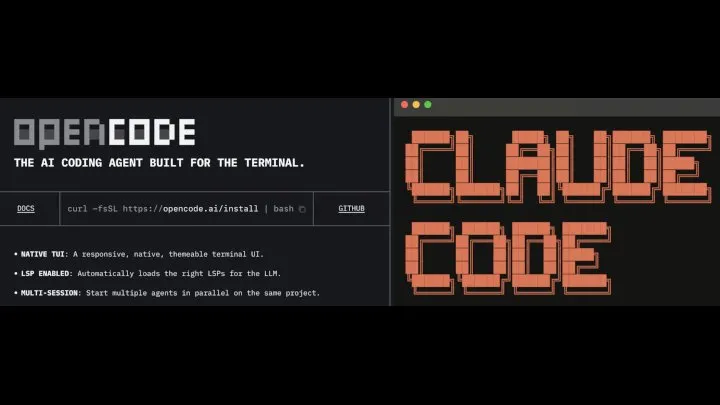
In short: As of September 5, 2026, choose OpenCode for model freedom, local inference, and an MIT-licensed foundation. Choose Claude Code for a more integrated Anthropic experience across terminal, IDE, desktop, and web. My recommendation: start with OpenCode if you are undecided; pay for Claude Code when its integrations and Claude models measurably improve your workflow.
The model matters as much as the agent. Comparing interfaces alone or declaring a universal winner would be misleading: the right choice depends on your providers, privacy constraints, and budget.
What do OpenCode and Claude Code offer?
OpenCode
OpenCode is a coding agent available in the terminal, as a desktop application, and as an IDE extension. Its official repository is published under the MIT license.
Its core difference is model choice. The provider documentation lists more than 75 providers and support for local models. You can bring your API keys, use a compatible service, or select one of OpenCode’s optional offers.
Claude Code
Claude Code is Anthropic’s coding agent. It reads a repository, edits files, runs commands, and integrates with the terminal, IDEs, the desktop application, and the web.
Its strength is a consistent experience around Claude models and Anthropic’s ecosystem. The official documentation covers project instructions, skills, hooks, subagents, and MCP connections.
Which differences actually matter?
| Criterion | OpenCode | Claude Code |
|---|---|---|
| Tool code | MIT license | Anthropic product |
| Models | More than 75 providers and local models | Claude models; third-party cloud providers on some surfaces |
| Surfaces | Terminal, desktop, IDE extension | Terminal, IDE, desktop, web |
| MCP | Local and remote servers, OAuth | MCP servers and external integrations |
| Automation | Agents, commands, and extensible configuration | Skills, hooks, subagents, and plugins |
| Billing | Free tool; model or service paid separately | Eligible subscription or API consumption |
Which tool gives you more model freedom?
OpenCode clearly wins on this point. You can select a provider, define an OpenAI-compatible URL, or connect a local model. That flexibility helps you compare models, control where data goes, or avoid depending on a single catalog.
Claude Code remains centered on Claude, although its documentation mentions integrations with Amazon Bedrock, Google Cloud, and Microsoft Foundry. You then change the billing infrastructure, not the model family.
Which one integrates better into daily work?
Both tools have moved beyond a simple chat in a terminal. OpenCode offers MCP and an optional LSP integration that feeds diagnostics to the agent. Claude Code offers MCP, lifecycle hooks, persistent instructions, and several official surfaces.
Claude Code is a better fit if you want a cohesive stack documented by Anthropic. OpenCode is a better fit if you want to assemble your own stack and replace a provider without changing agents.
Can you use local models?
OpenCode officially supports local models through compatible providers. This can keep code away from a remote service, but local does not automatically mean safe: check logs, allowed tools, permissions, and the execution machine.
Claude Code is designed to call Claude models through a subscription, the API, or a compatible cloud platform. It is not the right choice if your requirement is fully offline inference.
How much do OpenCode and Claude Code cost?
The prices below were checked on September 5, 2026. They can change, and taxes depend on your country.
| Option | Listed price | What you pay for |
|---|---|---|
| OpenCode with your keys | Free tool | Consumption from your selected provider |
| OpenCode with a local model | Free tool | Hardware, energy, and operations |
| OpenCode Go | $10/month | Capped access to a selection of open models |
| Claude Pro | $20/month or $200/year | Standard usage shared with eligible Claude products |
| Claude Max 5x | $100/month | Session capacity advertised as five times Pro |
| Claude Max 20x | $200/month | Session capacity advertised as twenty times Pro |
| Claude Code via API | Variable | Tokens consumed according to the model and provider |
The OpenCode Go documentation lists an optional $10-per-month subscription with usage limits. The official Claude plan guide lists the Pro and Max prices above. The Claude Code cost documentation explains that API use is billed by tokens and that cost depends on the model, repository size, and usage habits.
The cheapest option therefore depends on your workload. A local or inexpensive model can make OpenCode very affordable. A long session on a large repository can quickly increase an API bill. A Claude subscription simplifies budgeting, but its usage limits are not a guaranteed unlimited capacity.
Does open source mean better or more private?
No. OpenCode’s MIT license lets you inspect, modify, and redistribute the tool. It does not make your selected remote model open source, and it does not guarantee that your data stays local.
Before adopting either agent, check:
- where the model processes your prompts and code;
- which commands the agent can run;
- how keys and conversations are stored;
- which human approvals precede a write, commit, or deployment;
- which contractual terms cover your team and data.
OpenCode gives you more control over the technical assembly. Claude Code gives you a more integrated path. In both cases, security depends mainly on your configuration and the permissions you grant.
When should you choose each tool?
Choose OpenCode if:
- you want to test several model families;
- a local model or internal endpoint is required;
- the MIT license and the ability to audit the tool matter;
- you prefer paying the provider of your choice directly;
- you are willing to configure more of your environment.
Choose Claude Code if:
- you have already chosen Claude models;
- you want consistent official surfaces;
- Anthropic’s hooks, skills, subagents, and integrations structure your work;
- a Claude subscription or centralized billing already exists;
- you prioritize integration over provider independence.
Should you really keep only one?
Not necessarily. A team can standardize on Claude Code for Claude-focused work while keeping OpenCode to test other models or use local infrastructure. That coexistence remains useful only if permission, secret-handling, and validation rules stay identical.
However, avoid multiplying agents without a reason. Two configurations, two histories, and two access policies increase maintenance. Keep the second tool only when it solves a measurable constraint.
Conclusion
OpenCode is the best default choice for exploration and provider control. Claude Code is the better choice once you have validated Claude and want Anthropic’s full experience.
Start with a trial on the same real tasks: fixing a bug, changing multiple files, and reviewing a diff. Compare output quality, supervision time, and observed cost. That result is more useful than a generic benchmark because the agent, model, repository, and your instructions form a single system.
Sources
- OpenCode general documentation
- Official OpenCode repository and MIT license
- OpenCode supported providers
- OpenCode Go pricing and limits
- Claude Code overview
- Claude individual plans
- Claude Code cost management
Sources consulted on September 5, 2026.
Frequently asked questions
Should I choose OpenCode or Claude Code?
Choose OpenCode if you want to switch providers, use local models, or keep a tool under the MIT license. Choose Claude Code if you prefer an integrated experience around Claude models and Anthropic's official tools.
Is OpenCode really free?
The OpenCode software is free and open source, but the model you use can be paid. You can bring your own API keys, run a local model, or subscribe to an optional offer such as OpenCode Go.
How much does Claude Code cost?
Claude Code can be used with an eligible Claude subscription or with API billing. As of September 5, 2026, the individual Pro, Max 5x, and Max 20x plans are listed at $20, $100, and $200 per month.
Is OpenCode open source?
Yes. OpenCode's official repository publishes the tool under the MIT license. That license covers the tool, not necessarily the external models or services you connect to it.