GEO One Year Later: The AI Search Optimization That Works
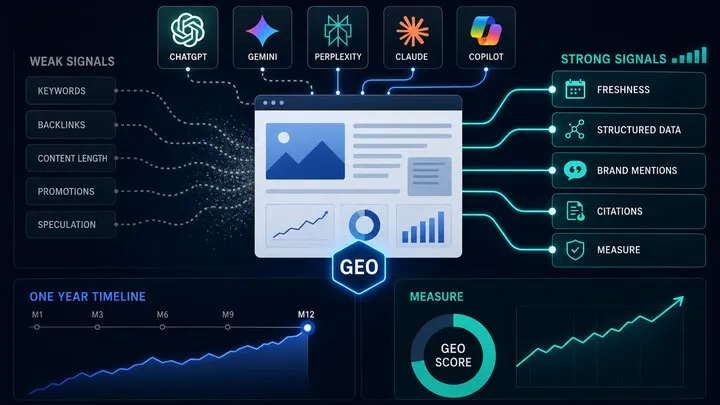
In short: As of September 5, 2026, GEO mainly improves how an already selected source is cited; it guarantees neither discovery, rankings, nor traffic. Prioritize answer-first content, a consistent entity, third-party mentions, and useful updates. An llms.txt file may provide a summary to an agent that consults it, with no demonstrated benefit. Measure each engine separately with a stable protocol.
In one year, GEO — Generative Engine Optimization, meaning the optimization of a site for the answers of AI assistants such as ChatGPT, Perplexity, Gemini, or Claude — has gone from an experimental acronym to a checkbox in nearly every SEO tool. Nothing to do with geolocation: the goal is to get your content cited, not geolocated. Generating a file, adding structured data, and tracking a score create the impression of a new, manageable channel. Reality is more nuanced. In the sample studied by SE Ranking, referrals attributed to AI assistants account for 0.32% of sessions in 2026, up from 0.24% in 2025 and 0.02% in 2024. The volume remains low, but some visits may have strong intent. Assess it through your own conversions rather than a universal average.
After twelve months of tools and promises, the right question is therefore no longer “should you do GEO?” but what can you actually improve?
One year later, what does GEO really prove?
The evidence mainly concerns how an already selected source is presented, and much less its discovery, ranking, or traffic. This distinction prevents a useful technique from becoming an impossible promise.
What holds up: improving prominence
An engine discovers or retrieves documents, selects some of them, builds an answer, and then chooses its citations. Prominence describes the visibility given to a source: its position, frequency, and association with a claim.
A July 2026 critical survey reviews 45 studies. The famous “+40%” improvement associated with the Princeton research came from an experimental environment limited to five documents. It measured prominence, not visits, leads, or conversions.
What does not hold up: a universal formula
No GEO checklist guarantees a presence in AI-generated answers. An end-to-end test cited in Buffy’s critical analysis even found that an overly “citation-oriented” rewrite reduced top-10 presence by about 16%.
Google AI Overviews also illustrates the difference from conventional SEO. In February 2026, these answers appeared for 48% of the queries tracked, while only 17% of their citations came from the organic top 10, according to BrightEdge. Traditional rankings still matter, but they are not enough to explain generative selection.
Why don’t AI assistants follow the same rules?
Each lab combines its own crawlers, indexes, third-party sources, and retrieval mechanisms; a global rule would be misleading. Permission in robots.txt does not mean the same thing for a training crawler, a search index, or retrieval triggered by a user.
Published observations about the labs
The table combines observations from the EZY study, conducted across 83 sites for 12 weeks, with official documentation. It is a snapshot as of September 5, 2026, not contractual behavior or a prediction.
| Lab | robots.txt | llms.txt | JSON-LD | JS rendering | Opt-out |
|---|---|---|---|---|---|
| OpenAI | documented per crawler | observed in this sample | not documented | not documented | documented per crawler |
| Anthropic | documented per crawler | observed in this sample | documented through web_fetch |
not documented | documented per crawler |
| documented by use case | observed in this sample | documented | yes (Web Rendering Service) | documented | |
| Perplexity | documented by crawler | not observed in this sample | documented for citations | not documented | documented by crawler |
| Meta | documented by crawler | observed in this sample | not documented | not documented | documented per crawler |
Google can execute JavaScript and render pages through its Web Rendering Service. Rendering is not documented for the other labs in the table. In this sample, Meta generated the most llms.txt requests; this does not predict its future behavior.
Fragmentation also affects referrals. In April 2026, ChatGPT accounted for 76.85%, followed by Gemini at 9%, Perplexity at 7.73%, Copilot at 3.76%, and Claude at 2.66%, according to StatCounter. An optimization designed for a single assistant therefore covers an increasingly fragmented market.
Are GEO modules worth their magic button?
They automate useful files and metadata, but none can create authority, freshness, or third-party mentions on its own. Their value primarily depends on how much maintenance work they remove.
Products documented as of September 5, 2026
- Yoast 28.4 generates
llms.txtand exposes its entity graph through a REST endpoint. - AIOSEO 5.0.0.1 provides a generator for
llms.txtandllms-full.txt. - Rank Math 1.0.277.2 combines its LLMS Txt module with an MCP agent.
- SEOPress 10.1 documents
llms.txt,Linkheaders,mcp.json, andagent-card.json. - Shopify has allowed customization of
llms.txt,llms-full.txt, andagents.mdsince May 28, 2026. - Nuxt offers an official
nuxt-llmsmodule, displayed at around 32,000 weekly downloads when accessed.
These versions and features come from the official pages listed in the sources, accessed September 5, 2026. They measure integration maturity, not a demonstrated visibility gain. Choose the interface you actually need, without an arbitrary ranking.
What use remains for llms.txt?
Publish a clean file if generating and maintaining it costs almost nothing. It may provide a summary to an agent that chooses to consult it; no increase in discovery, citations, or rankings has been demonstrated. Check requests in your logs instead of inferring usefulness from the file’s presence alone.
Which signals actually correlate with AI citations?
The associations that recur across several observational datasets concern brand mentions, useful freshness, entity clarity, and an easily extractable structure; none is an isolated causal lever. These vendor studies use incompatible samples and definitions, so their effect sizes cannot be compared directly.
Mentions and entity before backlinks alone
Across 75,000 brands, Ahrefs measures a correlation of 0.737 between AI visibility and YouTube brand mentions. Web brand mentions range from 0.66 to 0.71, compared with about 0.22 for backlinks.
But correlation does not imply causation. A well-known brand naturally generates more mentions, links, searches, and visibility. Adding a video or markup guarantees nothing.
Your entity micro-checklist has five items:
- the same business name on the site and third-party profiles;
- accessible About and contact pages;
- identified authors with biographies;
OrganizationorPersonmarkup matching visible content;sameAsproperties pointing to official profiles.
JSON-LD describes the entity; it creates neither authority nor citations.
Useful freshness, not a cosmetic date
TheStacc observes cited content that is 368 days fresher than Google’s organic results, with 76.4% of leading ChatGPT citations less than 30 days old. Among 116,379 citations with measurable dates, or 1.4% of the 8.2 million citations studied, Parse.gl measures a median Last-Modified age of three days; 65.3% are less than a week old and 80.6% less than 30 days old.
Last-Modified remains an imperfect proxy: a rebuild, CDN, or template change can alter the header without an editorial improvement. Do not change only a date. Revalidate figures, content, screenshots, compatibility, links, and recommendations. Useful freshness reduces the risk of obsolescence; cosmetic freshness adds no information.
Extractable structure and solid evidence
How can you measure GEO every month without fooling yourself?
Freeze the questions and conditions, separate the engines, keep the raw answers, and wait for a repeated signal. Without a stable protocol, tracking measures changes in your method as much as changes in your visibility.
1. Establish three baseline cycles
Every month, use 20 to 30 prompts across two or three engines. Keep the same language, region, and mode. Do not change the set between cycles; every change creates a new version. Establish three baseline cycles before interpreting a trend.
A rolling eight-week window only applies to automated weekly tracking. It should not be mixed with the manual monthly protocol.
2. Keep a complete collection record
For every answer, record:
- the exact prompt;
- the engine and its mode;
- whether Web search was enabled;
- the model, if visible;
- the language and country;
- a fresh session or a signed-in account;
- personalization disabled, where possible;
- the date and time;
- the raw answer and cited URLs.
Repeat a small sentinel subset two or three times to estimate variability. For Google AI Overviews, record “overview not triggered” as a distinct result, not an empty answer.
3. Measure each engine separately
The Lucreya CONSENSUS study reports the same winner across three engines for only 5 of its 14 category-and-intent queries, or 36%. Do not merge the results. Compare each engine against its own historical baseline.
Track readable ratios:
- Brand Visibility %: number of answers that mention the brand divided by the total number of answers;
- Citation Rate: number of answers that cite your domain divided by the total number of answers;
- AI Share of Voice: mentions of your brand among mentions of your brand and your competitors;
- Average Mention Position: average position of the first mention, optional for a small business.
Count at most one mention per brand in each answer. Define how ties and answers without a list will be handled before collection, then keep that rule. Also distinguish “ghost citations,” where the domain appears without the brand name: a substantial share of brand presences may be invisible in analytics. Composite scores remain specific to each provider.
4. Wait for a repeated signal and compare it against logs
Act only on a change in the same direction across two cycles, confirmed by logs or real citations. Summarize each engine with winning or losing URLs, hypotheses, and one tested action.
GA4 does not see crawlers that do not execute JavaScript. In server logs, search for declared user agents, then verify published IP ranges where they exist. Anthropic does not publish any, so Claude traffic identified by user agent alone must remain unverifiable. For crawlers that support this check, perform reverse DNS lookup and then confirm that the resulting hostname resolves back to the original IP.
D. Plouffe reports from five months of logs for one site that only 12% of observed “Googlebot” traffic and 41% of observed “ChatGPT-User” traffic was authentic. He also reports one identified click for every 280 fetches in those logs. This single-site case illustrates spoofing and the gap between crawler activity and visits; it is not a Web-wide average.
Conclusion
GEO is not a standalone channel. It is a discipline of readability, entity consistency, and observation. Making a page accessible, answering clearly, supporting claims, and keeping information current also benefits the conventional Web.
I would publish a clean llms.txt if the tool generates it without maintenance. I would devote most of the time to genuinely useful pages, original evidence, third-party mentions, and logs.
My investment order would be simple:
- technical accessibility;
- citable and current content;
- entity consistency;
- monthly measurement;
- a paid platform only at scale.
Choose your prompt set, capture three comparable cycles, then test one improvement at a time.
Sources
Links accessed September 5, 2026:
- Optimizing Visibility in Generative Engines: A Critical Survey — arXiv
- Does GEO Actually Work? — Buffy
- AI Traffic Research Study — SE Ranking
- AI chatbot referral market — StatCounter
- AI Overviews: One Year of Presence, Size and Citing — BrightEdge
- AI Brand Visibility Correlations — Ahrefs
- Freshness Signals in AI Search — theStacc
- How Old Are the Pages AI Cites? — Parse.gl
- The CONSENSUS Protocol — Lucreya
- Do AI Bots Read llms.txt? — EZY Research
- Reading AI Traffic in Server Logs — D. Plouffe
- Yoast SEO — WordPress.org
- AIOSEO llms.txt Generator
- Rank Math LLMS.txt
- SEOPress Agent Readiness
- Customize llms.txt, llms-full.txt, and agents.md — Shopify
- Nuxt LLMs module
Frequently asked questions
What does the acronym GEO stand for?
GEO stands for Generative Engine Optimization: optimizing a site to be cited in the answers of AI assistants such as ChatGPT, Perplexity, Gemini, or Claude. It has nothing to do with geolocation.
Does GEO replace traditional SEO?
No. GEO complements SEO by making a source easier to understand and cite in AI-generated answers, while indexing, authority, technical quality, and usefulness remain essential.
Does an llms.txt file improve rankings in ChatGPT or Gemini?
There is no evidence that llms.txt is a ranking signal. It may provide a summary to an agent that chooses to consult it, with no demonstrated increase in discovery, citations, or rankings.
Which signals are associated with citations by AI assistants?
Studies mainly find associations with brand mentions, useful freshness, a consistent entity, answer-first structure, and original data. An isolated correlation does not prove causation.
How should visibility in AI-generated answers be measured?
Keep a versioned set of 20 to 30 prompts, test two or three engines every month under the same conditions, retain the raw answers, and compare each engine against its own historical baseline. Add real citations and verified server-log data.
Should every AI crawler be allowed in robots.txt?
There is no universal rule. Separate training, indexing, and user-triggered retrieval bots, then decide according to your goals and rights; blocking one crawler may reduce some citations without preventing every form of indirect reuse.