Modern Fullstack Development: My Go-To Stack in 2025
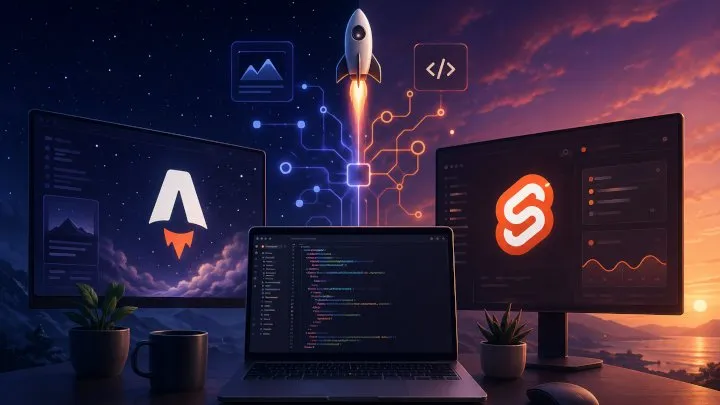
In short: As of September 5, 2026, I recommend Astro with Svelte for sites and applications where content dominates, then Astro endpoints for a simple backend. Move to Node.js with Fastify or Express when the API needs to run separately. React remains relevant for a complex interface. Use AI as an accelerator, never as a substitute for technical validation.
Which fullstack stack should you choose in 2026?
The web development landscape is constantly evolving. After working with numerous technologies since 2008, I favor a progressive stack: Astro for structure, Svelte for interactivity, and Node.js when the backend requires a standalone service.
This combination avoids turning a simple project into a complex platform. You can start with little client-side JavaScript, then add only the building blocks justified by the product.
Why combine Astro and Svelte on the frontend?
Astro renders components as HTML and CSS by default. Its islands architecture loads client-side JavaScript only for components explicitly marked as interactive. It is therefore particularly well suited to company websites, portfolios, blogs, and interfaces where content remains central.
Svelte complements this approach with concise interactive components. Svelte 5 introduces runes to declare reactive state explicitly and compiles components into optimized JavaScript.
Why not choose React by default?
React remains a good choice for an interaction-heavy application, a team that already knows it, or a product that depends on its ecosystem. That is not a reason to impose it on every project.
For a company website or portfolio, Astro with targeted Svelte components reduces the amount of logic executed in the browser. The best stack is not the most popular one: it is the one that meets the need with the least lasting complexity.
Which backend should you use with this stack?
Astro endpoints can expose data or serve as an API. They are sufficient when the backend stays close to the site and shares its deployment lifecycle.
Choose Node.js with Fastify or Express when the API becomes an independent service, serves multiple clients, or requires separate operations. This separation should address a concrete need, not an architectural preference.
What role should AI play?
AI can speed up library exploration, propose a first implementation, explain an error, or review a change. It is useful as a working partner.
It should not decide architecture, security, or production readiness on its own. Verify its code, dependencies, and assumptions. A plausible result is not necessarily correct.
How can you learn this stack without losing focus?
Start with HTML, CSS, JavaScript, and TypeScript. Then learn Astro through a simple site. Add Svelte only for a real interaction, and try an endpoint before introducing a separate server.
This progression shortens the learning loop. You understand each tool’s role when the project reveals the need for it.
Conclusion
Simplicity remains the best criterion. For most content-focused projects, I would start with Astro, Svelte, and Astro endpoints. I would separate the backend with Node.js only when product constraints demand it. Do not choose a technology because it is trendy; choose it because it solves your problem.
Sources
Frequently asked questions
Which fullstack stack should you choose in 2026?
For a content-rich site or an application with limited interactivity, I recommend Astro with Svelte for interactive components, then Astro endpoints for a simple backend. Add Node.js with Fastify or Express when the API becomes a separate service.
Should you choose React for a fullstack project?
React is a strong fit for complex application interfaces and teams that already know its ecosystem. For a company website, portfolio, or content-focused project, Astro with a few Svelte components is often simpler.
What role should AI play in fullstack development?
Use AI to explore an API, produce a first draft, or review code, but keep human validation for architecture, security, and testing. It speeds up the work without replacing an understanding of the system.
How long does it take to learn this fullstack stack?
The timeline mainly depends on your knowledge of HTML, CSS, JavaScript, and TypeScript. Learn Astro and its rendering modes first, then add Svelte and backend development as your project requires them.